| Incident Date | March 26, 1991 |
| Location | Waryong Mountain, Daegu |
| Status | Unsolved / Cold Case |
| Discovery | September 26, 2002 |
In 1991, five boys disappeared while searching for salamander eggs on Mount Waryong in Daegu. Eleven years later, their remains were discovered, but the case remains unsolved.
Introduction: A Day That Stood Still
The date was March 26, 1991. South Korea was experiencing a historical turning point as it held its first local elections in 30 years. It was a temporary national holiday, and the atmosphere in the city of Daegu was one of civic duty and springtime leisure. In the Seongseo district, five elementary school students—U Cheol-won (13), Jo Ho-yeon (12), Kim Yeong-gyu (11), Park Chan-in (10), and Kim Jong-sik (9)—decided to take advantage of the day off.
They told their families they were heading toward Mount Waryong to “hunt for salamander eggs.” Carrying small tin cans and wearing light spring jackets, they were seen by several neighbors near the mountain trails around 9:00 AM. They were described as energetic and excited. No one could have predicted that this innocent outing would evolve into a mystery that would consume the nation’s attention for more than three decades.
I. The Initial Disappearance and National Mobilization
When the sun set and the five boys had not returned, the village of Seongseo fell into a state of panic. The parents spent the first night on the mountain with flashlights, calling their sons’ names. The initial police response, however, was criticized for being dismissive. Authorities suggested the boys might have run away to the capital, Seoul, leading to a critical loss of time during the “golden hour” of the investigation.
The “Frog Boys” Cultural Phenomenon As the days turned into weeks, the case became a national obsession. The media mistakenly identified “salamander eggs” as “frog eggs,” leading to the moniker “The Frog Boys.” The search effort was unprecedented:
Parental Struggle: The fathers of the victims became symbols of national grief. They quit their jobs and spent years traveling the country in a truck covered with their sons’ photographs, following thousands of leads that ultimately led to dead ends.
Manpower: Over 300,000 police and military personnel were deployed to Mount Waryong and the surrounding Daegu area.
Publicity: Approximately 8 million flyers were printed. The boys’ faces were featured on millions of milk cartons, cigarette packs, and public transit posters.
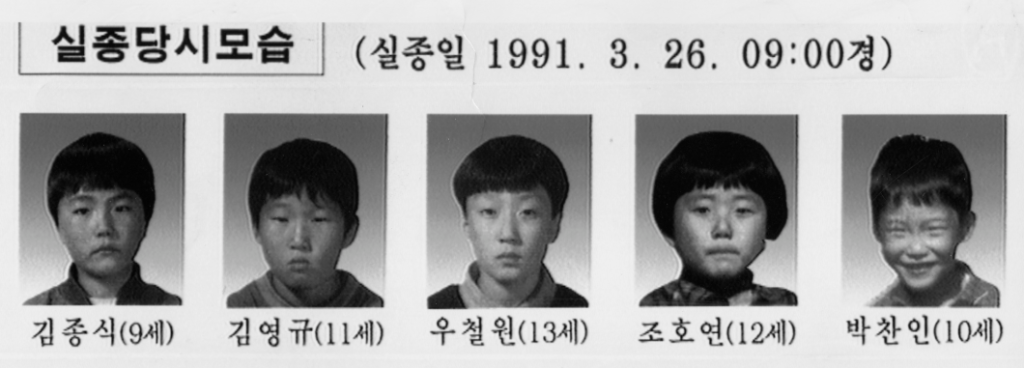
The five boys who disappeared in Daegu on March 26, 1991. [JOONGANG ILBO]
II. The Discovery (September 26, 2002): A Decade of Silence Broken
For 11 years and 6 months, Mount Waryong kept its secret. On September 26, 2002, two men foraging for acorns in a remote gully discovered fragments of clothing and human remains. The discovery site was only about 500 meters from the boys’ village, raising immediate questions about how such a massive search operation could have missed the remains for over a decade.
The Investigative Controversy The discovery was immediately marred by procedural errors. Before a professional forensic team could secure the site, local police began excavating the remains with pickaxes and shovels. Forensic experts later lamented that this “investigative vandalism” likely destroyed critical trace evidence, such as foreign fibers, hair, or soil composition that could have linked a suspect to the site.
Initially, the police issued a statement suggesting the boys had died of hypothermia and exhaustion, claiming they got lost in the rain and huddled together for warmth. This theory was rejected by the families and the public, who pointed out that the boys were intimately familiar with the mountain and were only a 10-minute walk from the nearest residential lights.
III. The Forensic Deep Dive: Decoding the Trauma
A specialized team from Kyungpook National University, led by forensic experts including Professor Chae Jong-min, conducted a meticulous month-long autopsy. Their findings effectively moved the official cause of death from “natural causes” to “homicide.”
1. The Signature of Homicide (Blunt Force Trauma) The most significant evidence was found on the skulls. Three of the five skulls showed clear signs of blunt force trauma. However, the indentations were unusual: dozens of rectangular marks and small, square-shaped punctures.
- Expert Analysis: Forensic analysts hypothesized that the wounds were inflicted by a heavy industrial tool. One prominent theory pointed to a “welding hammer” or a customized industrial pick, as the wounds showed a level of precision and repetitive force not typically seen with common rocks or knives. One boy’s skull exhibited over 25 distinct strike marks.
2. The Mystery of the Knots The boys’ clothing provided another layer of complexity. Several jacket sleeves were found tied in extremely tight, complex knots. * The “Industrial Knot” Hypothesis: Forensic specialists noted that these were not the loose, messy knots a child would tie. Instead, they appeared to be professional-grade knots used in specific industries such as shipyards, heavy logistics, or military applications. This suggested that the boys had been restrained by someone with technical or specialized training.
3. Forensic Entomology and Soil Analysis Investigators also looked into whether the bodies had been at the site since 1991. Some experts pointed to a lack of certain biological markers—such as specific moss growth or bone decay patterns—usually found on remains exposed to the elements for 11 years. This led to a “Dump Theory,” suggesting the killer may have hidden the bodies in a dry, indoor location before returning them to the mountain years later, though this remains an unproven hypothesis.
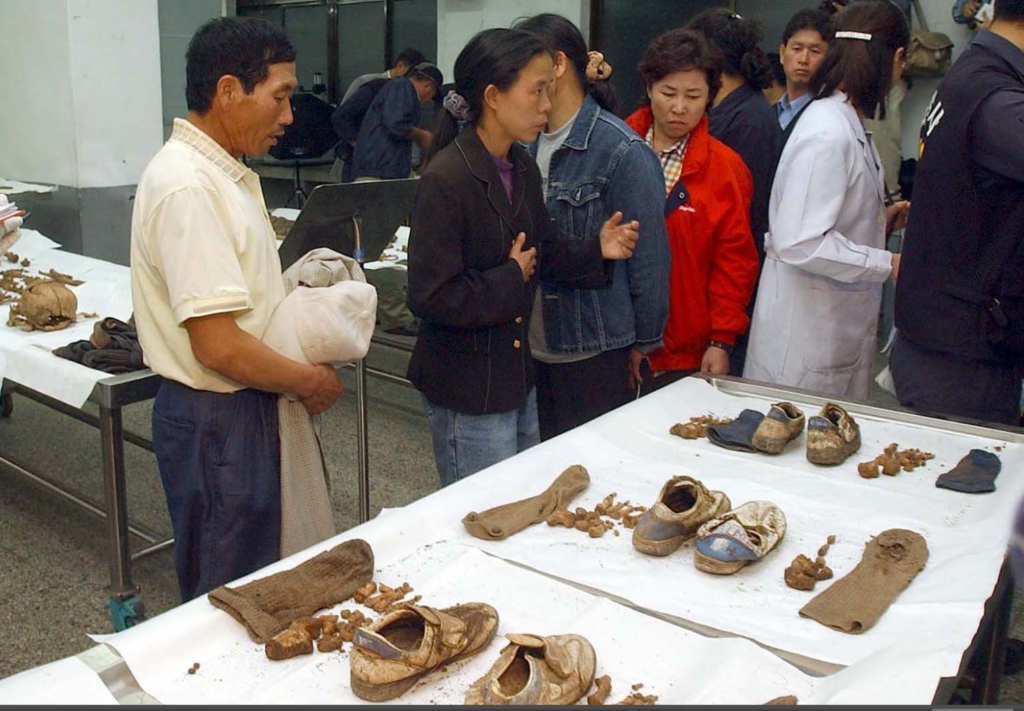
The parents of the Frog Boys examine belongings recovered from Mount Waryong. [JOONGANG ILBO]
IV. Unresolved Theories and Investigative Hurdles
Due to the significant passage of time between the crime and the discovery, physical evidence was scarce. This led to several competing theories:
The Chance Encounter: Another theory suggests the boys encountered a predator on the mountain who possessed the tools and skills (knots/specialized hammer) to commit the crime quickly and hide the evidence.
The Military Range Proximity: Mount Waryong was located near a military firing range. Some theorized the boys might have been accidentally hit by stray bullets and a cover-up followed. While lead fragments were found near the bones, forensic experts maintained that the primary cause of death was blunt force trauma, not ballistics.
V. The Legal Outcome and Social Impact
The statute of limitations for the case officially expired on March 25, 2006, which was then 15 years for murder under South Korean law. This meant that even if a suspect were identified or confessed later, they could not be prosecuted.
The case became a major catalyst for legal change. In 2015, South Korea abolished the statute of limitations for first-degree murder (known as the “Taewan Law”), though it could not be applied retroactively to the Frog Boys case. Today, the case remains a permanent archive of grief, a reminder of investigative failures, and a call for more advanced forensic practices.
Conclusion: A Legacy of Unanswered Questions
The Frog Boys case is more than an unsolved crime; it is a national tragedy that redefined how South Korea handles missing persons and forensic evidence. While the perpetrator was never caught, the story of these five boys remains a pivotal chapter in the history of Korean criminal justice—a haunting reminder that some secrets are buried deep, but the search for truth never truly ends.
Sources
- Kyungpook National University Forensic Autopsy Report (2002)
- Daegu Metropolitan Police Investigation Archives (1991–2006)
- National Forensic Service (NFS) of South Korea: Technical Analysis of Clothing and Knots
- SBS Documentary Archive: ‘Unanswered Questions’ (그것이 알고 싶다)
- Yonhap News Agency: Historical Search and Rescue Records
Film Adaptation
The Frog Boys case has also been depicted in South Korean popular culture. The most well-known adaptation is the 2011 crime drama film Children…, directed by Lee Gyu-man. The movie is based on the real-life disappearance of the five boys and the long investigation that followed.
Rather than focusing only on the crime itself, the film explores the emotional toll the case had on the families, the media frenzy surrounding the investigation, and the controversies that emerged during the police inquiry. Through dramatized characters such as investigative journalists and forensic experts, Children… attempts to reconstruct the events surrounding the tragedy while raising questions about the failures and limitations of the investigation.
The film renewed public interest in the case and introduced the Frog Boys tragedy to a younger generation who had not experienced the 사건 firsthand. Even decades later, the mystery of what happened on Mount Waryong continues to resonate in Korean society.
Trailer of Children… (2011), a film based on the Frog Boys case.